This article explains what the standard requires, who bears responsibility, and how connected monitoring technology helps you demonstrate compliance continuously – not just at the point of inspection.
What is EN81-28?
EN81-28 is the European standard for remote alarm systems on lifts for the transport of persons and goods. Published by the European Committee for Standardisation (CEN), it belongs to the EN 81 family of lift safety standards.
The standard was first published in 2003 and updated in 2018. Its purpose is to ensure that anyone trapped in a lift can summon help and that help is reliably available. In the UK, EN81-28 is adopted as BS EN81-28 – technically identical to the European version. The standard applies across EU and EEA member states, making it the baseline for lift emergency communication compliance throughout Europe.
EN81-28 applies to:
- New lifts installed after the standard's effective date
- Existing lifts undergoing significant modernisation
- Any lift where the emergency telephone system is replaced or upgraded
What does EN81-28 require?
The standard sets out several technical requirements that every compliant lift emergency telephone system must meet.
Two-way voice communication
The lift car must have a device that allows a trapped passenger to establish two-way voice communication with a response centre. The device must be operable without prior knowledge – a single clearly marked button must initiate the call. SafeLine's emergency phone communication platform is designed around this requirement.
24/7 staffed response
The response centre must be available at all times. There is no provision for unmanned periods or voicemail. The response centre must acknowledge the call within 60 seconds of connection.
Lift identification
When a call is received, the response centre must be able to identify exactly which lift is calling – building address, floor, and lift number. This is particularly important in multi-lift buildings and large estates.
Backup power
The system must remain operational during a mains power failure for a minimum of one hour – long enough for a rescue to be arranged.
Regular test calls
The system must automatically transmit a test call at least once every 72 hours to confirm the communication path is functional. This generates a regular audit trail of compliance evidence.
Who is responsible for compliance?
Responsibility for EN81-28 compliance sits with the building owner, or the management company acting on their behalf. A lift contractor has a duty to install and maintain a compliant system, but the building owner cannot delegate away the liability.
Under the Health and Safety at Work Act 1974 and the Lifting Operations and Lifting Equipment Regulations (LOLER) 1998, building owners must ensure lifts are maintained in a safe condition. A non-compliant emergency telephone is a direct breach of that duty.
For residential buildings, the Landlord and Tenant Act places further obligations on freeholders and managing agents to keep communal lifts in safe working order.
In practice, building owners and estates managers should:
- Ensure their maintenance contract explicitly covers EN81-28 compliance
- Retain records of regular test call logs
- Act promptly when non-compliance is identified at inspection
EN81-28 in the UK: BS EN81-28 and the Equality Act
In the UK, EN81-28 is adopted as BS EN81-28. Post-Brexit, the UK retains the standard as part of the BS EN series – the technical content is identical to the European version. BS EN81-28 is referenced by the Health and Safety Executive and in the technical guidance supporting the Building Regulations as the benchmark for lift emergency communication.
The Equality Act 2010 adds a further dimension. Emergency communication systems must be accessible to users with hearing or speech impairments. For most installations, this means:
- Visual indicators alongside audio alarms
- Induction loop compatibility where hearing loop provision is required
- Clear, high-contrast labelling on the alarm button
For public-facing buildings – including retail, transport hubs, NHS facilities, and local authority offices – the duty to make reasonable adjustments under the Equality Act reinforces EN81-28 compliance as a legal baseline, not a best-practice aspiration.
The PSTN switch-off and its impact on EN81-28 compliance
Many lift emergency telephones in the UK are still connected to the Public Switched Telephone Network (PSTN) – the traditional copper telephone network. BT Openreach has confirmed the full PSTN switch-off will complete by 31 January 2027. After that date, any lift telephone still relying on a PSTN landline connection will stop making calls.
This is not a theoretical future risk – it is a confirmed infrastructure change with a hard deadline, and a direct compliance risk for every building still running a landline-connected lift phone.
Migration to a cellular (4G or 5G) or VoIP-based emergency telephone removes the dependency on the copper network entirely. Cellular systems are particularly resilient: they remain operational during local broadband outages and maintain connectivity independently of the building's internet infrastructure.
If your current maintenance contract does not include a confirmed plan for PSTN migration ahead of the deadline, this should be a priority conversation with your service provider. Read our full guide to the PSTN switch-off for lift operators for a step-by-step breakdown.
How monitoring technology supports continuous compliance
Demonstrating EN81-28 compliance is an ongoing requirement, not a one-off event. The standard's 72-hour test call requirement means that every compliant system should be generating regular, logged evidence that the emergency communication path is working.
Connected lift monitoring systems can automate this entirely:
- Automatic test call logging – every transmission is recorded with a timestamp, providing a continuous audit trail without manual intervention
- Real-time fault alerts – if a test call fails, whether due to a hardware fault, a connectivity issue, or a power failure, the platform alerts your team before a trapped passenger discovers the fault
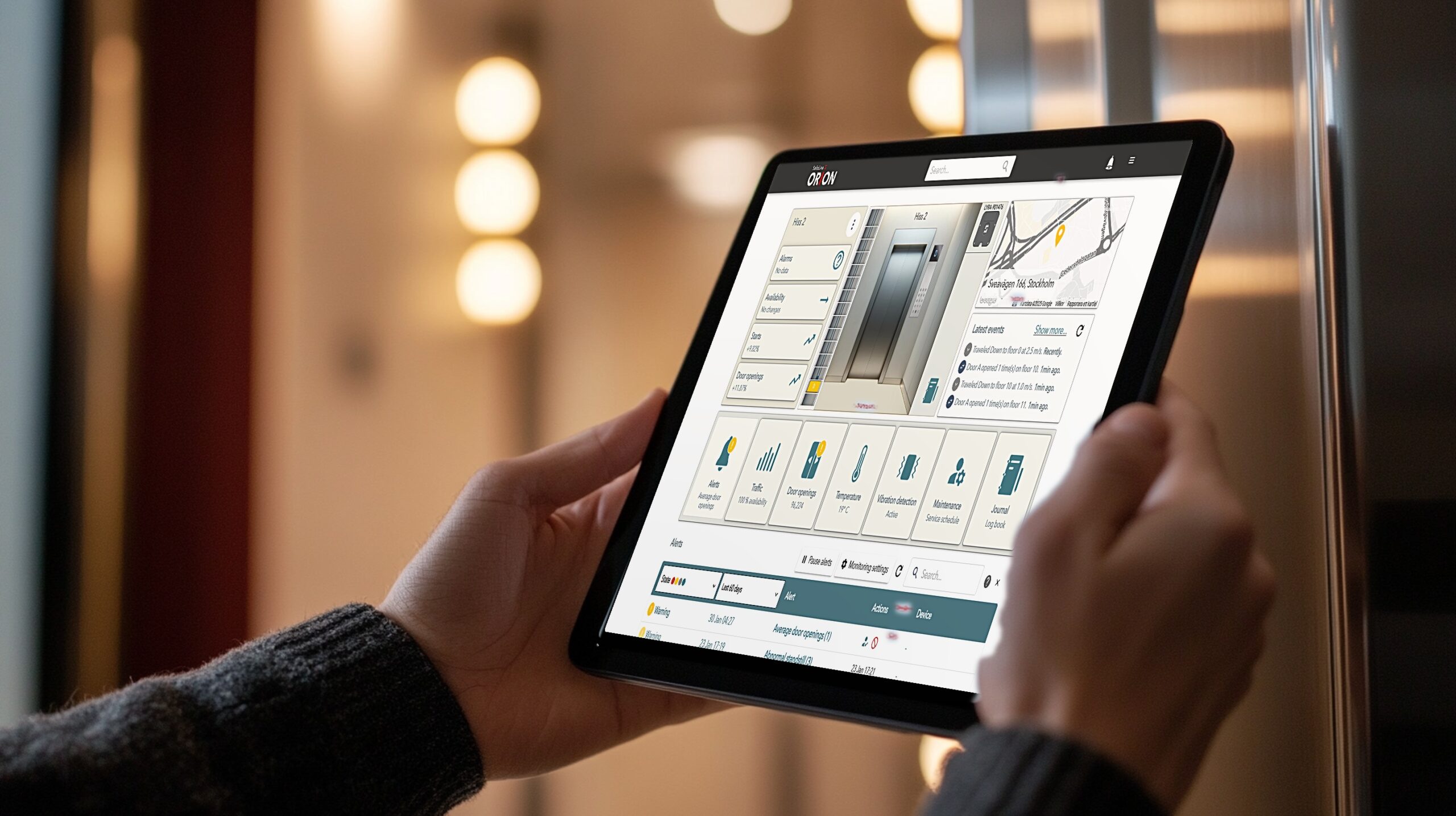
- Multi-site visibility – for estates with multiple lifts across multiple buildings, a single dashboard shows the compliance status of every lift in real time
- LOLER inspection support – when your next thorough examination is due, monitoring logs provide ready evidence of ongoing compliance, reducing the administrative burden on your team
The practical shift is significant. Rather than discovering a non-compliant telephone at the point of a LOLER inspection, continuous monitoring surfaces issues as they happen – giving estates managers time to act before a failure becomes a regulatory incident or a passenger emergency.
The evidence problem
Meeting EN81-28 is one thing. Proving it is another.
For most building owners, the record of test calls comes from the same company that maintains the lift. That is a single source with no independent check. If a test call is missed, or a line has failed quietly, the owner often finds out only at the next inspection, or when a real alarm does not connect.
This is where a monitoring platform changes the picture. It gives the owner a dated, independent record of what actually happened, held separately from the maintenance contractor's own reporting.
How SafeLine meets EN81-28
SafeLine meets the emergency-call requirement with three parts working together. No single part does it alone.
SafeLine SIM provides the connectivity. It is a managed, multi-network mobile connection, so the lift is not dependent on a fixed telephone line. SafeLine SL6 is the emergency telephone. It triggers the EN81-28 emergency call and the automated test call, and it connects up to six voice stations across the car, machine room, pit, and landing. SafeLine Orion is the platform that logs and timestamps every event, including each test call and each emergency call, so the record is dated and available in one place.
Read that as one system. SafeLine SIM connects, the SL6 calls, and Orion records. EN81-28 emergency-call compliance is the result of all three, not of any one component.
How to demonstrate compliance
A building owner who wants to show EN81-28 compliance can work through four questions.
Is there a two-way voice link in every lift, and does it reach a service that can respond? Is the three-day test call running, and does it follow the real alarm path? Is the battery backup present and monitored? And is there a dated record of all of this, independent of the maintenance contractor?
If the answer to the last question comes from a logging platform such as SafeLine Orion, the owner holds the evidence directly. Compliance stops being something taken on trust and becomes something on record.
Frequently asked questions
Does EN81-28 apply to older lifts?
EN81-28 applies directly to new installations and to lifts undergoing significant modification. However, LOLER requires that all in-service lifts are maintained in a safe condition. In practice, this means the emergency telephone on any lift – regardless of age – must be functional and connected to a staffed, 24/7 response centre.
What are the consequences of non-compliance?
A non-compliant emergency telephone is a reportable finding in a LOLER thorough examination. In serious cases, the examiner may recommend that the lift is taken out of service until the fault is remedied. Building owners may also face liability if a passenger is harmed as a result of a failed emergency call.
Is BS EN81-28 the same as EN81-28?
Yes. BS EN81-28 is the UK adoption of EN81-28. The technical content is identical – only the national prefix differs.
How often must the test call be sent?
EN81-28 requires that an automatic test call is transmitted at least once every 72 hours to confirm the communication path is operational. The test call record forms part of your compliance audit trail.
Does EN81-28 cover VoIP and cellular systems?
EN81-28 specifies the functional requirements for emergency communication – it does not prescribe the underlying technology. A cellular or VoIP system that meets the functional requirements (two-way voice, 60-second acknowledgement, 72-hour test, one-hour backup power) is fully compliant. PSTN, 4G, and VoIP systems can all satisfy EN81-28 if correctly configured.
What are the top mistakes with EN81-28 compliance monitoring setups?
A common mistake is treating one component as compliance on its own. EN81-28 compliance depends on three parts working together: connectivity through SafeLine SIM, the emergency call itself through SafeLine SL6, and the logged, time-stamped record in SafeLine Orion. Another mistake is relying on manual test calls instead of automated ones, which leaves gaps in the audit trail. A third is assuming a lift is compliant with no record to prove it, because an auditor needs the log, not just the call.